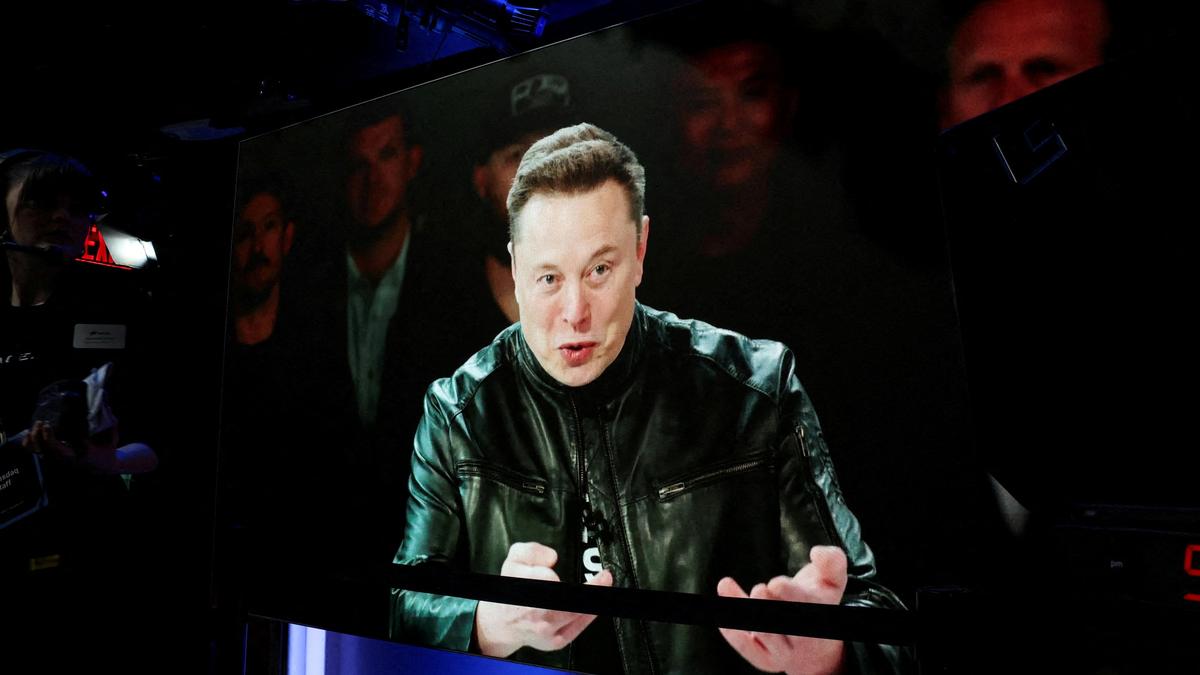
Technopreneur Elon Musk’s affinity for superlatives is well-known, particularly when it comes to selling his business ideas. It was therefore not a coincidence that his company SpaceX’s stock market debut on June 12, 2026 was laden with superlatives.
Mr. Musk, who already holds the record for being the planet’s richest person, became the first trillionaire in the world through the biggest-ever initial public offering (IPO), with SpaceX also set to be the fastest-ever entrant to the coveted Nasdaq-100 index.
However, SpaceX’s entry has raised concerns over the company’s valuation; the relaxation of rules that enables the company to enter indices like the Nasdaq-100 within a short span of time; and the increasing concentration of wealth among a few.
Meteoric rise
The rise in Mr. Musk’s estimated wealth was meteoric, from about $13.9 billion in 2017 to $1.1 trillion as of Friday, which is roughly an 80-fold increase within a span of nine years. His wealth is nearly four times that of the second richest, Larry Page, who co-founded Google.
The chart below shows the five richest persons in the world and Mukesh Ambani of Reliance Industries, who is the richest person in India. Their combined wealth is about 60 per cent of India’s estimated GDP for 2025-26.
New York City’s mayor Zohran Mamdani, an avowed democratic socialist, in a reaction on X after SpaceX’s IPO, said, “Reason #1,000,000,000,000 why we should tax the rich”.
The chart below shows the average wealth of tax units (individuals or households) in the top 0.0002, 0.0001 and 0.00005 percentiles, taken from a research paper brought out by a team from the University of California, Berkeley, in late 2024 for the U.S. Internal Revenue Service (IRS).
It shows that while the wealth of the crème de la crème increased significantly in the three reporting periods that were studied, the taxes they paid as a percentage of their wealth (tax-to-wealth ratio) came down.
Money “left on the table”
The gains were not just for Mr. Musk. Jay R. Ritter, Director, the IPO Initiative and Emeritus Professor, University of Florida’s Warrington College of Business, who has studied IPOs extensively, has defined money “left on the table” as the windfall profits made by investors who were allotted shares at the offer price, because of the jump in the share’s price on the first day of trading.
These usually include institutional or wealthy investors. The money “left on the table” is calculated by multiplying the total number of shares sold by the difference between the share’s offer price and its first-day closing price.
SpaceX planned to sell 555.6 million shares. The offer price of $135 jumped to $160.5 at the close of the first day, an increase of $25.5 (19% jump). This means the estimated windfall profits for these big investors were a whopping $14.16 billion (555.6 million x 25.5).
The chart below shows the data compiled by Prof. Ritter on the aggregate money “left on the table” during IPOs every year between 1980 and 2025 in the U.S. The lines indicate the number of IPOs and the bars show the aggregate money “left on the table” by the IPOs that year.
The high values in 1999 and 2000 were during the dot-com bubble. In 2025, the aggregate value of money “left on the table” for large investors by 90 IPOs was $13.3 billion. In comparison, the estimated windfall profits for large investors from SpaceX’s IPO were $14.16 billion—roughly one-fifth of the $75 billion SpaceX targeted to raise.
As per Prof. Ritter’s data, the second-highest by a company was Visa’s IPO in 2008, which resulted in a windfall profit of $5.08 billion as the offer price of its 406 million shares rose from $44 to $56.5 on day one.
Only 11 countries have bigger economies
SpaceX’s market capitalisation, estimated at $2.1 trillion at the close of the first day of trading, is less than the Gross Domestic Product of only 11 countries in the world—another indication of the unequal distribution of wealth. As per the World Bank’s GDP data available for 168 countries for the year 2024, the economies of the remaining 157 are smaller than SpaceX’s market capitalisation.
India’s economy is roughly 1.8 times the size of SpaceX’s market capitalisation. Germany (~2.2x), China (9x) and the U.S. (~14x) are the only ones with economies more than twice the size of the company.

India comparison
SpaceX raised $85.7 billion through its IPO against its target of $75 billion. This is because the underwriters—the group of investment banks that managed the IPO process for SpaceX—exercised in full the overallotment option to purchase an additional 83.3 million shares above the 555.6 million shares the company initially planned to sell.
To put this in the Indian context, the money raised by SpaceX on the first day of its IPO is more than India’s defence budget for 2026-27 (₹7.85 lakh crore), as the chart below shows.
Budgeted estimates for health, agriculture and education combined do not add up to even 50 per cent of the $85.7 billion the company has managed to raise in a single day through its IPO.
The ten biggest IPOs from India in terms of the money they raised are shown in the chart below. The money raised by SpaceX is equivalent to the combined value of funds raised by roughly 170 of the biggest IPOs to have come out of India.
Overvaluation concerns
TThe sky-high valuation of SpaceX has come under criticism, with many pointing out that the valuation rested on Mr. Musk’s ability to sell his futuristic business plans rather than on strong financials or near-term growth projections.
The table shows the four biggest-ever IPOs. SpaceX is the only company that reported losses in the year before its IPO.
Three businesses sit inside the newly-listed company —Starlink, SpaceX and xAI (which absorbed Twitter) —and, as the financials later show, only one of them makes money.
SpaceX, despite not reporting profits, has significantly improved its launch capabilities, with the number of launches of Falcon 9, its most active launch vehicle, steadily increasing from 96 in 2023 to 134 in 2024 and 165 in 2025. xAI, on the other hand, has been reporting significant losses since it came into existence in 2023.
The company’s filings with the SEC, which report the income (or loss) in terms of its “segments”—Connectivity (Starlink), Space (SpaceX) and AI (xAI)—show losses being made by the latter two.
The IPO has made SpaceX the sixth biggest company in the world in terms of market capitalisation and the only one on the list with negative net income.
Prof. Ritter’s data also shows that such companies with a high price-to-sales ratio (market capitalisation divided by annual revenue), particularly those that have not reported profits, have rarely added value to buy-and-hold investors over a three-year period. SpaceX’s price-to-sales ratio is 100x, another “never-seen-before” number.
Those who are bullish argue that the valuation does not reflect current earnings but the near-monopoly the group enjoys in reusable launch vehicles and in satellite internet through Starlink, coupled with Mr. Musk’s track record of turning a loss-making Tesla profitable at scale.
The prospectus section of SpaceX’s filings with the Securities and Exchange Commission in the U.S. said the company is the “most ambitious, vertically integrated innovation engine on (and off) Earth with unmatched capabilities to rapidly manufacture and launch space-based communications that connect the world, to harness the Sun to power a truth-seeking artificial intelligence that advances scientific discovery, and ultimately to build a base on the Moon and cities on other planets”. The two trillion-dollar questions are when, and at whose cost.