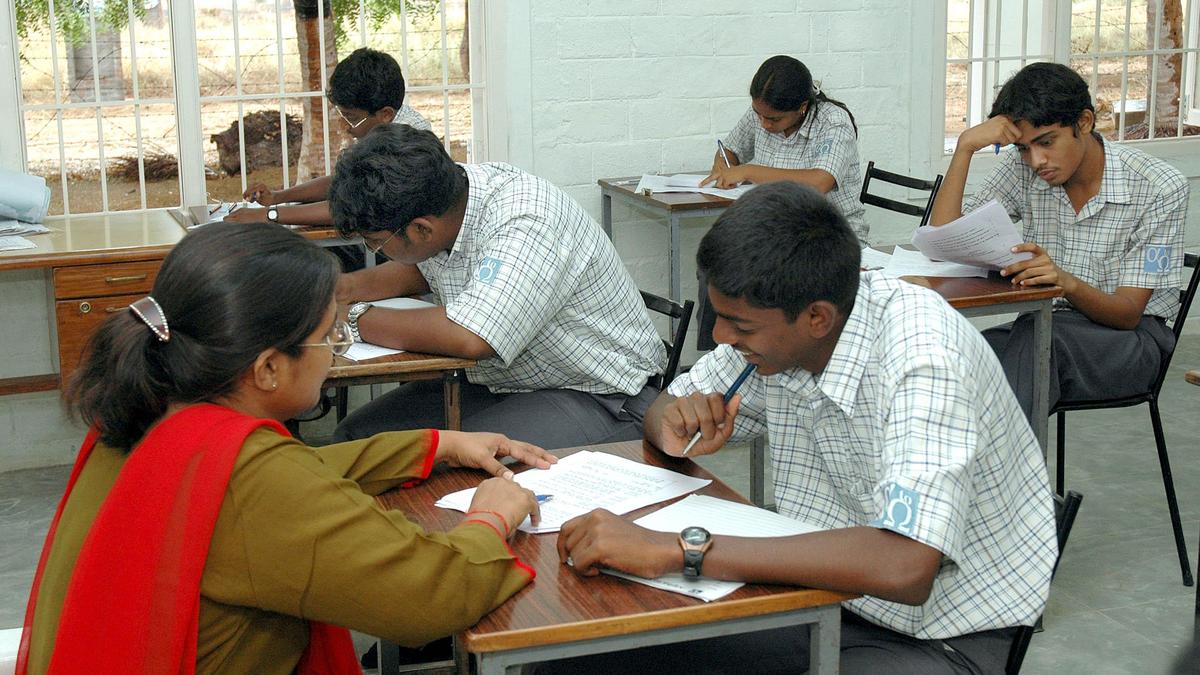
Students at Alpha to Omega Learning Centre, a school for children with learning disabilities in Chennai
| Photo Credit: PICHUMANI K
The Unified District Information System for Education (UDISE) 2025-26 report has raised concerns about Children With Special Needs (CWSN) enrolled in schools, whose numbers have remained stagnant over the past eight years despite initiatives to get more of them enrolled. As per the data, there were 21.66 lakh CWSN in schools, a number that has remained fairly constant over the years. While one could argue that the overall number of children enrolled in schools has also remained fairly the same, the other question to be answered in this context is whether all the CWSN in the country are getting enrolled in schools.

The 2011 Census said that there were 32.5 lakh disabled children in India, just under the age of nine. If one were to include persons with disability in the 10-19 age group, the number increases to 78.7 lakh. The number of CWSN in schools in 2025-26 were not even 30% of the 2011 Census data, needless to say that their numbers would have surely grown since.

In the absence of Census data and estimates of children with disability released by the government in recent years, The Hindu used the National Family Health Survey (NFHS-5) data on disability and the government’s population estimates in the Report of The Technical Group on Population Projects to estimate the number of CWSN in the country.
The estimate showed that the number of CWSN in India could have grown from 92.3 lakh to 98.8 lakh between 2018-19 and 2025-26. These estimates when compared with CWSN in schools showed that, only 22% of the children seem to have been enrolled in schools..

This is a conservative estimate since the population estimates could be calculated, as explained above, only for the 5-14 age group. This was compared with the total number of CWSN enrolled across primary, upper primary, secondary and higher secondary stages, which would include those who are at least a year or two older than 14.
Moreover, the number of CWSN shrinks significantly as they move up different stages of schooling. The shrinking is more pronounced among CWSN than the overall number of students enrolled. The table below shows the proportion of children in upper primary, secondary and higher secondary stages compared with their numbers in the stages before.

Nearly 75% of CWSN who have enrolled in primary school are in upper primary, data showed. This reduced to 48% between upper primary and secondary, and 46% between secondary and higher secondary levels. As the table shows, these shares are higher for the overall number of children.
The data also showed that the gender distribution remained worryingly the same despite minor fluctuations in the number of CWSN enrolled. Only about 43 of every 100 CWSN enrolled in schools are girls. However, the number of girls with special needs dropping out of schools seem to be lower than boys. The number of girls with special needs in upper primary level, for instance, is about 80% of those in primary level.

Shashank Pandey, lawyer and founder of the Politics and Disability Forum, who works on political representation of Persons with Disabilities said that underreporting of the numbers cannot be ruled out. He told The Hindu that at times the schools that provide data for the UDISE reports are not updated with the 21 categories of disabilities now recognised by the Rights of Persons with Disabilities Act, 2016, and still categorise students based on the eight categories provided in the 2011 Census.
Published – July 23, 2026 09:00 am IST