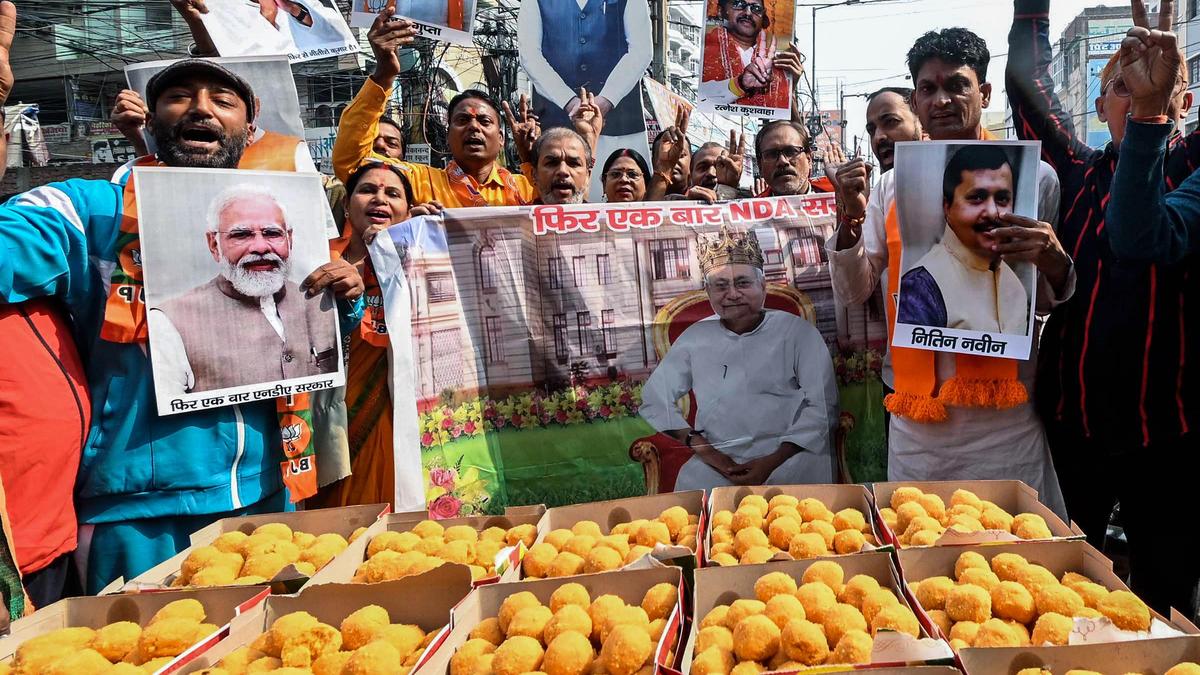
BJP supporters raise posters of Prime Minister Narendra Modi, Chief Minister Nitish Kumar amongst other leaders and offer sweets to celebrate NDA’s massive victory in Bihar assembly elections 2025, in Patna on Sunday.
| Photo Credit: ANI
Many factors contribute to the landslide victory of a political party or an alliance. This holds true for the recent victory of the National Democratic Alliance (NDA) in Bihar as well. The victory conveys two messages — that there was an overall approval of the work done by the incumbent NDA government under Chief Minister Nitish Kumar, and of the voters’ continued faith in the promises made by the NDA during its campaign. The results also point to the vital role of women voters in Indian elections. Not only did women voters turn out to vote in much larger numbers in 2025 as compared to all the previous elections, but they also seemed to have voted decisively in favour of the NDA, giving the alliance a significant lead.
The results
These results are a major setback for the Mahagatbandhan (MGB). But despite a rout in terms of seats, the Rashtriya Janata Dal (RJD) emerged as the single largest party in terms of votes polled. RJD leader Tejashwi Yadav led the campaign from the front. He managed to consolidate his core voters — mainly Yadavs and Muslims — but failed to attract voters from other communities.

Prashant Kishor’s Jan Suraaj Party (JSP) party polled just over 3% of the votes. However, one should credit Mr. Kishor for leading the campaign on the issue of job opportunities for residents in Bihar, rather than on the issue of migration of labour to industries outside Bihar. This message later resonated in the campaigns of other parties. The JSP appeared to attract large crowds and generated significant buzz. This created the popular perception that Bihar was heading for a three-cornered contest. However, the contest was essentially a bipolar one, as was the case in previous elections.
The NDA won 202 seats and polled 46.6% of the votes, while the MGB managed to win 35 seats with 37.7% of the votes. This is the second best performance of the NDA; in the 2010 Assembly elections, it won 206 seats. Together, the two alliances polled roughly 85% of the vote, with other parties receiving a much smaller share compared to earlier elections.
A large number of voters made up their mind about which party to vote for during the last few days of the campaign. Evidence from a survey suggests that 42% were late deciders, choosing who to vote for one or two days before voting or on the day of voting. Most of these late deciders voted either for the NDA (47%) or for the MGB (36%), while the JSP (3%) was not seen as a party that was likely to win or play a role in government formation.
Success of the NDA campaign
The NDA’s strategy of pitching its election campaign on large, State-level issues rather than on local issues seems to helped it in a big way. The NDA campaigned on the need for a double engine sarkaar (Nitish-Modi government) for faster development of the State. About half of the voters in Bihar believed it was necessary for the party in power at the Centre to also be in power in the State, while a little over one-third (37%) did not agree with this view. The NDA conveyed the message that this election was not about electing an MLA or Chief Minister, but to ensure that Bihar moves ahead on the path of development. It also warned the voters that if the MGB won, it could result in a return to ‘Jungle Raj’ — a reference to the poor law-and-order situation between 1990 and 2005 during Lalu Prasad and Rabri Devi’s leadership. This message seems to have appealed to a large segment of voters, especially women, who faced major challenges on account of the poor law-and-order situation.
Countering anti-incumbency
One major reason why the NDA government was able to overcome anti-incumbency was the high level of voter satisfaction with both the State and Central governments. Data show that nearly three-fourths of voters expressed satisfaction with the performance of both, creating a favourable environment for the NDA’s campaign.

Voters also reported notable improvements across key public services and infrastructure. More than three-fourths of the respondents said that the availability of electricity had improved, and nearly seven of every 10 believed that the conditions of roads had improved. They also said that there were improvements in social sector services. More than six of every 10 voters felt that the condition of government schools had improved, and a similar share reported better access to drinking water. A little over half (54%) believed that government hospitals were functioning better, while nearly half the respondents (48%) perceived an improvement in law and order. Crucially, more than three out of every five voters said they wanted to give the Janata Dal (United) or JD(U)-led NDA government another chance in Bihar.
The welfare schemes specifically targeting women also seem to have helped the NDA in mobilising women voters in bigger numbers in 2025 as compared to previous elections. Women had supported Mr. Kumar in earlier elections as well, due to his policy of sharab bandi (alcohol prohibition), policy of giving cycles and school uniforms to schoolgirls, and the Jeevika Didi scheme. Initial evidence suggests that women voters seem to have played an important role in NDA’s victory.
The MGB was unable to generate confidence among voters of its ability to provide better governance if elected. It also appeared much weaker than the NDA in mobilising support. While in the NDA, alliance partners drew voters from different castes and communities, the MGB largely reinforced support within its existing base and failed to bring in additional voters. Within the NDA, the Bharatiya Janata Party (BJP) attracted a large chunk of upper caste voters, the JD(U) brought in Kurmi votes, Upendra Kushwaha’s Rashtriya Lok Samta Party (RLSP) was instrumental in securing Koeri votes, and both the Hindustaan Awaam Morcha and the Lok Jan Shakti Party (R) attracted a large segment of Dalit votes.
It is important to note that the core base of the MGB was much smaller than that of the NDA. The alliance partners in the MGB — mainly the RJD, Congress, Vikassheel Insaan Party, and the Left parties — more or less have the same core support base, which includes Yadavs, Muslims, and poorer segment of voters. While the alliance of these parties helped in consolidating the core supporters of the MGB, it appeared unable to attract non-committed voters. Evidence suggests that over seven of every 10 (70%) of Yadavs and Muslims voted for the MGB in this election. But the alliance failed to win over voters of other communities.
Sanjay Kumar is a professor and political analyst. Views expressed are personal
Published – November 18, 2025 08:00 am IST