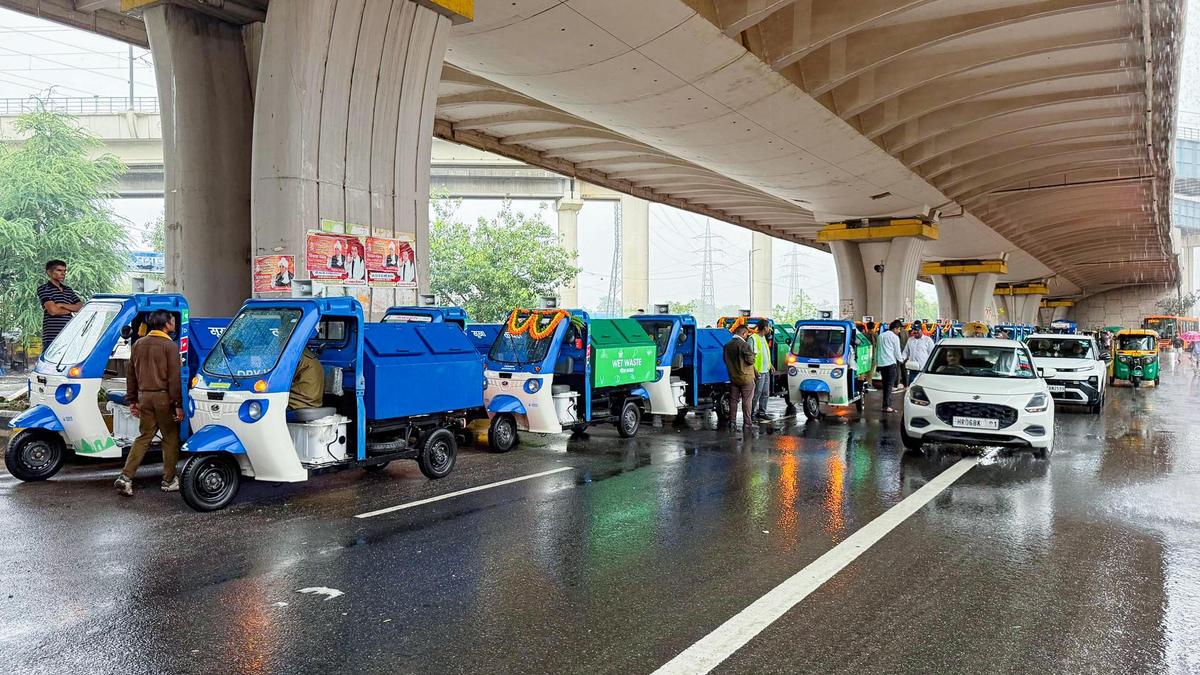
New Delhi, Jul 09 (ANI): A fleet of newly launched electric primary waste collection vehicles lined up under a flyover at Shalimar Bagh during the launch event by Delhi Chief Minister Rekha Gupta (unseen)for door-to-door garbage collection, in New Delhi on Thursday.
| Photo Credit: ANI
The Government of National Capital Territory of Delhi has given a firm push towards transition to electric vehicles through its new Delhi Electric Vehicles Policy, 2026, notified on June 30, 2026.
The policy has set aggressive deadlines for three-wheelers, light commercial vehicles like mini trucks and two-wheelers. Only EVs in the first two categories can be registered from January 1, 2027 and the similar deadline set for two-wheelers is January 1, 2028.
Though the policy is right in aiming high, considering Delhi’s pollution problem that is worsening every year, analysis shows that it could be an onerous challenge to meet these targets, especially for two-wheelers.
According to the Commission for Air Quality Management’s latest source-apportionment study, transport continues to be the biggest source of particulate pollution during winter (23%), besides contributing to secondary particulate matter.

Three-wheelers lead
The policy articulates why it is targeting two-wheelers, three-wheelers and smaller goods carriers on priority. Noting that two-wheelers account for nearly 67% of Delhi’s vehicle fleet, the policy says their “rapid electrification [is] critical for achieving meaningful reductions in vehicular emissions”. For three-wheelers and goods carriers in the category of light commercial vehicles, the policy says they exhibit high daily utilisation and mileage, “resulting in a disproportionate contribution to urban air pollution”.
The two segments are, however, at different stages of the transition to electric mobility. Three-wheelers account for only four per cent of the total vehicles in Delhi and 43.16% of them are already electric.

New registration of three-wheelers is seeing an even further jump towards EVs. Of the 12,809 new three-wheelers registered till the first week of July this year, 8,419 were electric (65.7%), which is roughly two out of every three vehicles.
Two-wheelers a challenge
The picture is markedly different for two-wheelers. Of the roughly 1.05 crore two-wheelers on Delhi’s roads, only 1.7% are EVs. In new registrations as well, two-wheelers are showing only marginal improvements and their shares in the last two years were in fact smaller than the previous two years.
Moreover, Delhi is not switching to EV two-wheelers at a noticeably faster rate than the country at the moment, for the rapid transition it is targeting by the end of 2027.

The number of two-wheelers getting registered in Delhi every year shows the massive leap needed in sales. Of the 5.68 lakh two-wheelers registered in 2025-26, only 41,263 (7.25%) were EVs.

Even with a conservative assumption that the demand for new two-wheelers and consequently the two-wheeler registrations will remain at the same level, the sale of EV two-wheelers should see at least see a twelve-fold (1300%) jump by next year if the policy’s target has to be met by January 1, 2028.
The real challenge would in fact be even more arduous since the registration of two-wheelers is increasing significantly year-on-year. For instance, the numbers went up by nearly 25% between 2024-25 (4.56 lakh) and 2025-26 (5.68 lakh).

The problem would be compounded further if Delhi decides to implement the end of life policy for vehicles strictly, as it would demand petrol and diesel fuelled two-wheelers that are respectively 15 and ten-years-old to be replaced with EVs.
The effective implementation of the EV policy will also require Delhi to ramp up the availability of support infrastructure. Delhi Transco Limited has been tasked with expanding public charging facilities. Delhi presently has 771 charging points, which are unevenly distributed and highly concentrated in the southern region.

The data for charts were sourced from VAHAN, NITI Aayog, Department of transport, Delhi (ev.delhi.gov.in) and Commission for Air Quality Management in NCR and Adjoining Areas
Published – July 16, 2026 08:00 am IST