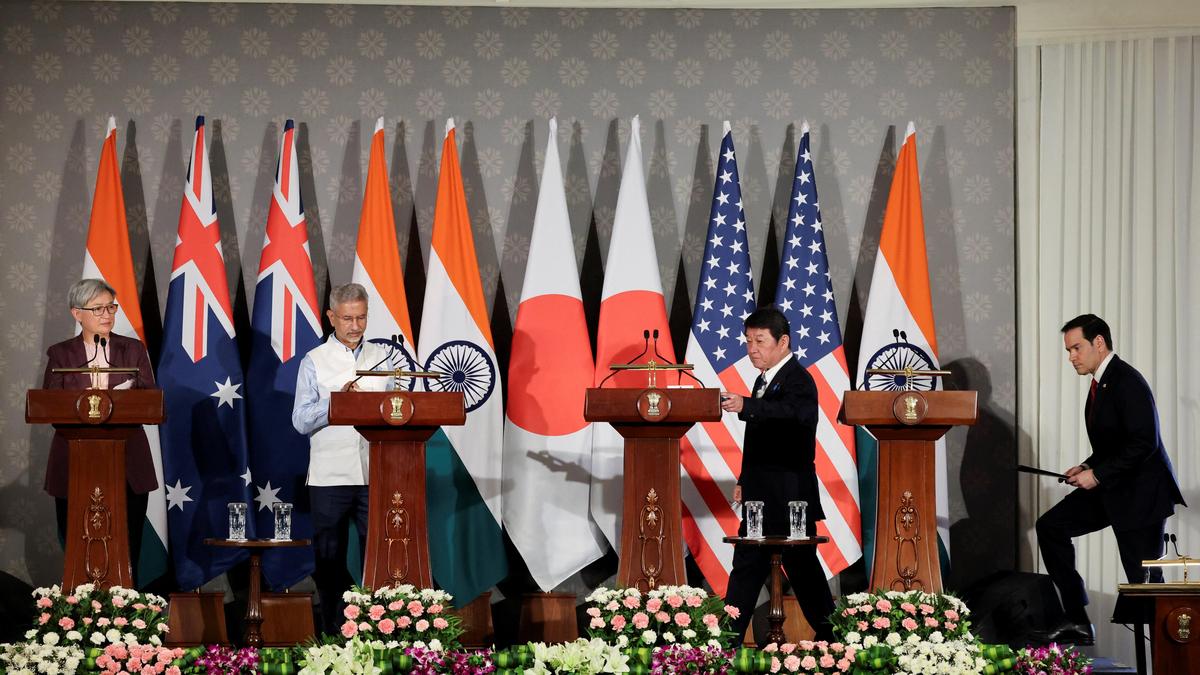
U.S. Secretary of State Marco Rubio, Australian Foreign Minister Penny Wong, Japanese Foreign Minister Toshimitsu Motegi and Indian Foreign Minister Subrahmanyam Jaishankar arrive to attend a joint press conference in New Delhi, India, May 26, 2026
| Photo Credit: ADNAN ABIDI
Last week, Japanese Prime Minister Sanae Takaichi was in New Delhi for the 16th India-Japan Annual Summit, her first visit to India since assuming office. The two sides reaffirmed their commitment to a free and open Indo-Pacific. The reaffirmation, however, comes at a moment when the idea of the Indo-Pacific appears to be losing its principal champion. On June 16, the Pentagon renamed the U.S. Indo-Pacific Command back to the U.S. Pacific Command, reversing a change it had made in 2018.
The renaming of the Command in 2018, although symbolic, recognised the region’s growing significance and acknowledged India’s centrality to the U.S.’s regional strategy. The reversal suggests that the region no longer enjoys the priority it once did in Washington. In fact, the National Security Strategy released by the U.S. in November 2025 prioritises the Western Hemisphere over the Indo-Pacific and mentions the Quad only in passing. It also assuages Beijing, which has long resented the formulation. Washington’s approach to managing its relations with Beijing is undergoing a change under the current administration.

All of this has put the future of the Quad under the scanner. If Washington retreats from the idea, the platform built around it inevitably invites questions about its relevance. These anxieties only add to a set of older concerns. How relevant or securitised is the Quad? Is it doing enough? And the criticisms aren’t without substance.
The first criticism entails the hesitation to name China. If the objective is indeed to shape the balance of power in the region, the silence over Beijing’s military and economic aggression is bad optics. However, this is largely a normative criticism. One can argue that the Quad’s reluctance to name Beijing is strategic, because positioning itself as an anti-China platform could dissuade smaller countries from associating with it.
Critics highlight the Quad’s hesitation to project itself as a security-centric grouping as another of its shortcomings. Given that Beijing poses hard security challenges to the region, any balancing effort has to be primarily security-centric. The extent of the grouping’s hesitation is evident in the members’ active effort to make an implicit distinction between Quad and the Quadrilateral Security Dialogue (QSD). There is a reluctance to use them interchangeably, even as the members acknowledge the grouping’s origins to be rooted in the first QSD in 2004.

The Quad’s reluctance to elevate the partnership to a 2+2 format — a bilateral ministerial dialogue comprising Foreign and Defence Ministers — is another pain point. Even as each of the four countries has formalised 2+2 meetings bilaterally with one another, the Quad continues to host meetings only at the leaders’ and Foreign Ministers’ level.
Domain of cooperation
The alleged overwhelming focus on non-security or soft issues is a related criticism. However, a review of the Quad’s agenda tells a different story. Even though the Quad assumed its current form in 2017, there was a lull for the first four years. It only picked up steam in 2021 during the COVID-19 pandemic, when the four countries held their first virtual leaders’ summit and announced a first set of initiatives. Within six months, the Quad held its first in-person leaders’ summit and expanded its areas of cooperation. The list today has grown to 37, of which 23 fall under security-related domains. Technology sovereignty, maritime capabilities and secure communications will be key in countering China in the years ahead.
Choosing the right areas of cooperation doesn’t necessarily reveal much, though. The type of cooperation and capital flows are key determinants in evaluating the seriousness of the grouping. But a review of the ‘type’ of cooperation in security-related domains suggests that Quad has a heavy focus on interoperability, data sharing, monitoring, and relief . While this is necessary and critically important for any security-focused grouping, Quad’s integration efforts are limited to civilian or non-military grade applications. Nonetheless, these integration exercises have dual-use capabilities and can be leveraged for even military-grade purposes.

The Quad’s focus on building capacity and resilient supply chains is also significant, especially as these relate to critical and emerging technologies, maritime, and communications — the domains where the bulk of contestation with China is expected.
The Quad’s security focus is not matched by its funding pattern. Based on what is available in the public domain, health and climate have been the primary beneficiaries. One can argue that since most security-related initiatives focus on integration and standard-setting, they do not require the same scale of dedicated funding. But building resilient supply chains would require substantial capital commitment, and that is where the gap is most visible.

The Quad’s recent commitment to mobilise $20 billion towards the Critical Minerals Initiative and Framework could change this picture. But it remains only a stated target at this point, with no funding committed or allocated. If security issues make up close to two-thirds of Quad’s initiatives, the funding allocation must follow suit.

The questions surrounding the Quad’s future will not be settled by nomenclature in Washington. They will be settled by whether the grouping backs its security-heavy agenda with capital.
Published – July 08, 2026 10:00 am IST