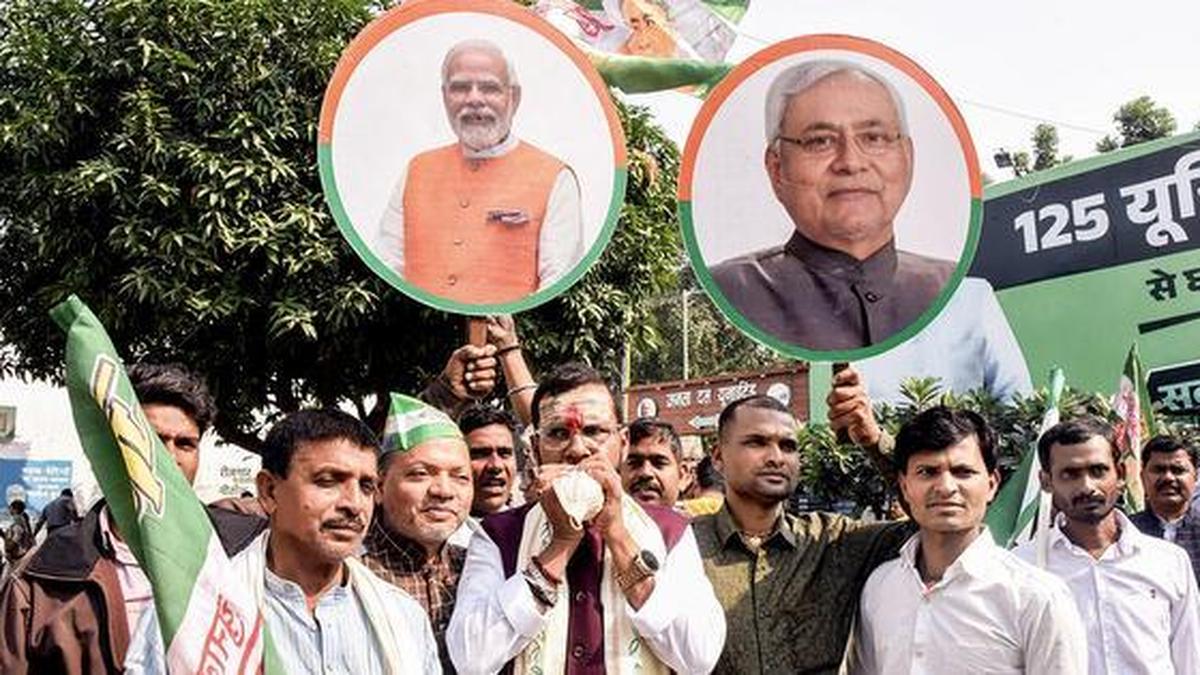
Janata Dal (United) (JD-U) supporters hold placards of Prime Minister Narendra Modi and Bihar Chief Minister Nitish Kumar as they celebrate NDA’s lead in the vote counting of the Bihar Assembly election 2025 at the party office, in Patna on Friday.
| Photo Credit: ANI
The National Democratic Alliance (NDA)’s victory in Bihar represents a well curated strategy for success. Two elements of this strategy merit attention and deeper analysis. The first is the near-perfect chemistry within the winning alliance and its visible absence in the Mahagatbandhan (MGB). All the partners in the NDA contributed to its success, while in the case of the MGB, much of the shoring up of the alliance was left to the Rashtriya Janata Dal (RJD). There was inter-dependence among the partners in terms of seat allocation within the NDA. However, in the MGB, there was again an overwhelming dependence on the RJD.
Second, key leaders in the NDA directed both the campaign of the alliance and that of individual partners. This was a recipe for victory. The fact that the NDA is the ruling alliance at the Centre also helped. On the other hand, the leaders among the MGB went their own individual ways and whenever visible, sang their individual political tunes, with little visible cohesion or a common focus.

The question of sharing seats
The five parties within the NDA resolved seat-sharing issues much before the closing of nominations. Within the NDA, the two major partners — the Bharatiya Janata Party (BJP) and the Janata Dal (United) or JD(U) — contested an equal number of seats and between them, accounted for more than eight of every 10 of the NDA candidates. The BJP ensured that its seat share was on a par with the JD(U) while the other partners — the Lok Janshakti Party (LJP), Hindustani Awam Morcha (Secular) or HAM, and Rashtriya Lok Morcha (RLM) — were allotted the remaining seats. The LJP, which had fought the 2020 Assembly polls on its own, was allotted a large chunk of seats. While this was a much-debated issue during the campaign, in retrospect, this strategy helped in keeping the alliance votes together. The smaller parties, though unhappy with the seat allotment, fell in line, given the unique dynamics among the constituents of the NDA. On the other hand, whenever the MGB was unable to settle seat-sharing issues, it permitted ‘friendly fights’ in several seats between coalition partners.
Also read: Decoding the NDA’s landslide win in Bihar
The results indicate that all the five alliance partners of the NDA contributed through a high individual score. Data based on a post-election survey done by PollsMap indicates that the NDA’s constituents, if contesting independently, would have more or less secured the same share of votes. The only exception would have been the BJP. In its case, the vote share, if the party had contested independently, would have been much higher. If the NDA got 81 seats more than last time, 24 of these seats (30%) came from the three smaller partners. The JD(U) recovered from the setback it faced in 2020 and won an additional 42 seats and the BJP increased its tally by 15 seats. Thus, all the parties in the alliance pulled together. The vote share of the NDA increased by over 9%, the bulk of which came from parties other than the BJP. This indicates a smooth vote transfer across alliance partners.

In the MGB, all the eight key parties saw a marginal decline in their vote share as compared to 2020. The decline in each case was less than 1%, with the highest being in the case of the Congress (0.77%). The RJD’s seat tally was down to one-third of what it won last time, though its vote share declined by merely 0.11%. This is indicative of the inability of the alliance partners to combine effectively and ensure a meaningful vote transfer. A decline of vote share across the board is also a reflection of their individual inability to enhance their respective vote shares. Within the MGB, while the RJD saw a decline in seats won, the performance of its alliance partners saw a sharper decline.
Leadership question
The leadership sweepstakes also assume relevance. The NDA did not consciously declare a chief ministerial candidate even though Nitish Kumar had been Chief Minister for most of the last two decades. This worked to its advantage. A review of the campaign indicates that the BJP went into the election under the leadership of Prime Minister Narendra Modi. No State-level leader of the BJP was projected during the campaign. The party highlighted what it felt represented its success in other States of north India and also showcased what it considered its record at the national level over the last decade.
The JD(U) focused on its achievements as part of ruling coalitions under the leadership of Mr. Kumar. Its campaign centred around welfare schemes and what it termed as good governance and a good law-and-order situation.
The three other parties in the NDA focused on their individual leaders and their specific core agendas, even as they highlighted the leadership of the Central government of which they are a part.

Survey data indicate that there was a clear 5% point lead that Mr. Kumar enjoyed over Tejashwi Yadav in the preference for Chief Minister. Past surveys have also indicated that most respondents focus more on the party than the candidate. More often than not, parties, especially in Bihar, are linked to the face of the leader. While the party as represented by its leadership is a key element, leaders on their own also contributed to bolstering the party vote. Thus, among those who voted for the BJP, JD(U), and the RJD, Mr. Modi, Mr. Kumar, and Mr. Yadav respectively accounted exclusively for one of every five votes — meaning that people voted for these parties primarily because of the leadership factor and they may have voted differently in the absence of the respective leader. A focus on the party in general and the leadership in particular was the principal approach adopted by all the NDA’s constituents.
While the MGB declared Mr. Yadav as its chief ministerial face, that did little to contribute to a unified campaign. It was also a decision which came a little late in the day. The Congress appeared a reluctant supporter of this move and this was evident in its campaign style. Declaring Mukesh Sahani of the Vikasheel Insan Party as the candidate for the post of Deputy Chief Minister did not help either. The Deputy Chief Ministerial candidate was himself not a contestant and all the 12 candidates of his party lost the elections.
While other factors may surely have contributed to the outcome, the fact that a significant chunk of the NDA’s votes came on the basis of the leadership factor suggests that the Modi-Nitish combination paid dividends for the winning coalition. The absence of such an arrangement in the MGB worked clearly to its disadvantage.
Dr. Sandeep Shastri is Vice President (Bengaluru), NITTE (Deemed to be University). Views are personal and do not represent the view of the institution.
Published – November 19, 2025 08:00 am IST