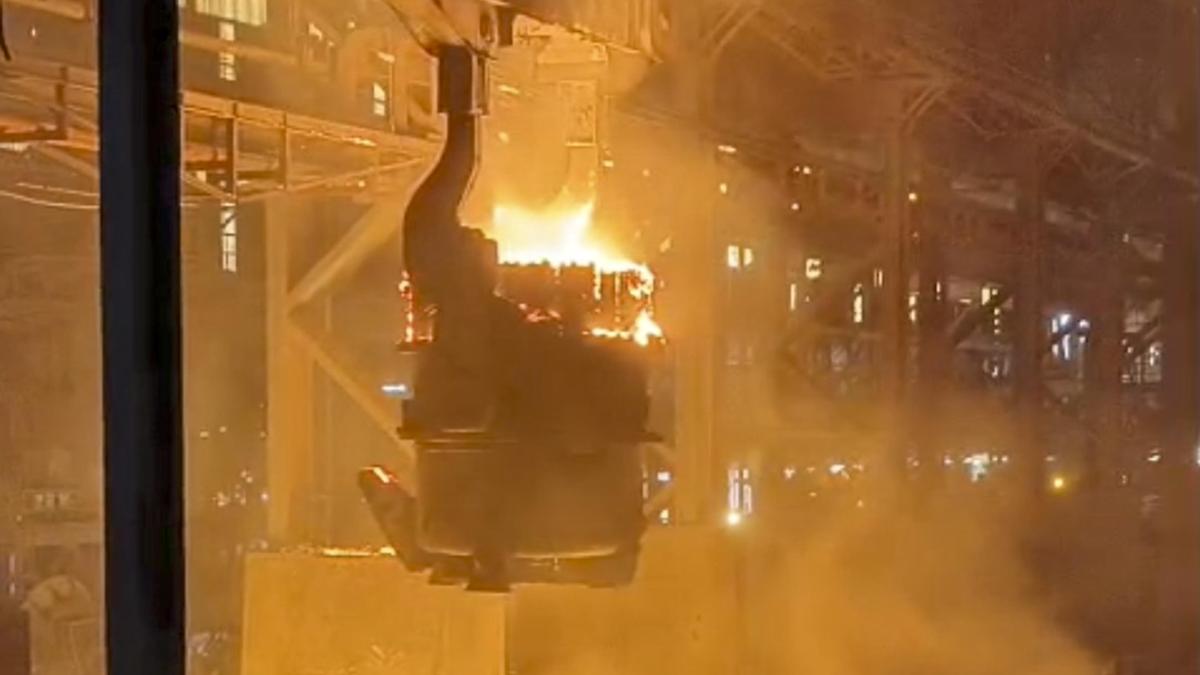
Flames erupt in Vizag steel plant after molten iron spilt while being moved in a bucket by a crane, in Visakhapatnam, Andhra Pradesh, Monday, June 8, 2026
| Photo Credit: –
The death toll from the explosion at the Rashtriya Ispat Nigam Limited-Visakhapatnam Steel Plant (RINL-VSP) on June 8, rose to nine on Wednesday. Following the incident, a familiar chain of bureaucratic responses has been triggered such as ex-gratia for the bereaved families and the constitution of an expert committee for a high-level probe. These were the same measures taken after the last major accident at the plant in 2014, and indeed after most workplace accidents across the country. But India appears to be lagging in strengthening institutional mechanisms needed to prevent such accidents.
The chart below shows the number of registered factories in each year and the number of employees in millions.
The problem begins with the very collection of safety data, as the gaps in the annual Standard Reference Notes (SRNs) of the Directorate General Factory Advice Service and Labour Institutes (DGFASLI) reveal.
The chart below shows the fatal and non-fatal injuries as per the Labour Bureau (LB) and (ClFs), which vary widely over the years, with a few showing unexplained swings in the SRNS
DGFASLI helps implement the Occupational Safety, Health and Working Conditions (OSH) Code, 2020. The OSH, for which the rules were notified only last month, renamed the DGFASLI as the Directorate General of Occupational Safety and Health.
Each SRN records industrial accidents in two sections: one from data compiled by the Labour Bureau and the other from DGFASLI’s own correspondence with Chief Inspectors of Factories. The two never match, pointing to lapses in reporting.
The reports also show DGFASLI struggling with heavy vacancies. As shown in the chart below, nearly 50% of the 349 sanctioned posts remained vacant as of 2023.
The country does not have enough factory inspectors, even in industrialised States such as Tamil Nadu.
This gets consequently reflected in the small fraction of factories inspected each year. The chart below shows the share of factories inspected by DGFASLI each year (in %). The inspections have dropped significantly in recent years, perhaps due to the staff crunch.
Moreover, many States simply do not report the required details. Many States did not furnish data on fatal and non-fatal incidents, either to the Labour Bureau, or DGFASLI, as per the SRNs. U.P., Karnataka and W.B. did not provide data even once.
With inputs from Nitika Francis and Sandhya K, who is interning with The Hindu
The data for the charts were sourced from Standard Reference Notes published by the Directorate General of Factory Advice Service & Labour Institutes (DGFASLI) and Accidental Deaths & Suicides in India (ADSI) published by the National Crime Records Bureau
Published – June 12, 2026 07:00 am IST